

A videoscope uses a miniature electronic image sensor near the tip to show what is inside a component. A fiberscope sends the image through a coherent bundle of optical fibers to an eyepiece or camera at the other end. Both inspect places the naked eye cannot reach, but the difference becomes important when the opening is tiny, the target is around a corner, or the finding must be recorded.
For industrial buyers, the better camera is the one that reaches the inspection surface and gives the operator a usable view. A higher-resolution display is of little help if the probe cannot enter the passage. A smaller fiberscope can be equally frustrating if the feature that matters is outside its viewing direction.
Quick answer: Choose a fiberscope when extremely small access or an optical image path drives the inspection. Choose a videoscope when digital sensor imaging, articulation or a larger conventional borescope format better serves the target. AIT's Milliscope HDF fiberscopes start at 0.35 mm, HDV digital videoscopes start at 1.0 mm, HDX adds articulation in 1.1 mm and 1.6 mm probes, and K Series and T Series cover larger industrial video borescope needs.
Two Ways to Bring an Image Out of a Component
Both instruments are types of borescope. The difference is where the image forms and how it reaches the inspector.
A lens at the inspection end forms an image that travels through aligned glass fibers. A camera handle can capture that fiber-delivered image and display or record it digitally.
A tiny image sensor captures the view inside the component and sends an electronic signal to the display. Imaging options and tip steering depend on the selected model.
That distinction explains why a fiber-optic fiberscope can remain useful when a camera sensor cannot fit, and why digital inspection becomes attractive when the same component needs frequent viewing, recording, or changes in direction.
Videoscope vs Fiberscope: The Differences That Affect a Purchase
The practical comparison is broader than image resolution. Probe diameter, the full access route, target direction, image recording and service requirements can each rule out an otherwise capable camera.
When a Fraction of a Millimeter Changes the Answer
Consider a machined cooling passage with a smallest opening of 0.8 mm. An HDV probe starting at 1.0 mm cannot pass through it, no matter how good the sensor is. The same is true for a 1.1 mm HDX. A suitably configured sub-0.8 mm HDF fiberscope is a more realistic place to start.
The reverse can happen in a larger cavity. A 2.0 mm access opening may admit several probe options, but a feature hidden along the sidewall might be difficult to see with a fixed forward view. At that point, the viewing direction or articulation capability may decide the inspection.
Fiber-optic access for exceptionally small passages.
Digital imaging where a direct or selected fixed view suits the route.
Digital imaging with two-way tip articulation for restricted access.
Diameter is the entry test, not the whole inspection: Allow for clearance, bends, restrictions, insertion length and a safe withdrawal route. The smallest listed diameter does not mean that every length, viewing angle or sheath option is available in that size.
For particularly narrow passages, AIT's micro borescope comparison examines how the three Milliscope technologies fit different access constraints.
Does a Digital Image Always Show More Detail?
Modern videoscopes can provide strong digital image quality, but the number printed on a screen or a camera specification is not the entire answer. Optics, illumination, field of view, focus distance and the surface being inspected influence whether an operator can identify a small defect.
There is another important distinction: Milliscope HD provides a 1080p video output, even though the image originates from an optical fiber bundle. The display resolution does not add optical detail that the bundle did not transmit. HDV and HDX use 160,000-pixel CMOS sensors at the distal end, so a direct comparison of "1080p" against "160,000 pixels" would mix two different specifications.
What matters on screen: Can the inspector distinguish the actual feature, under the expected lighting and working distance? A representative inspection sample is more useful than comparing unlike pixel-count specifications.
Recording also needs to be judged by the actual system. AIT's Milliscope HD fiberscope uses a camera handle and base unit for still images and video, while HDV and HDX provide direct CMOS imaging and USB recording. A blanket claim that fiberscopes cannot save images would be incorrect.
When the Camera Must Turn to See the Target
Insertion-tube flexibility and distal-tip articulation do different jobs. A flexible tube follows the passage. An articulating tip deliberately changes the viewing direction after reaching the target area. Some fiberscopes can articulate, and some videoscopes are fixed-view; the product design matters more than the category label.
Begin with access size and sheath construction when the restriction is too small for the available CMOS probes.
Use direct digital imaging when the inspection surface is visible from a known forward or side direction.
Two-way tip steering helps redirect the view after entry, when the passage and selected probe permit it.
When size permits, consider additional probe lengths, articulation controls and reporting features beyond the micro-probe family.
The HDX's published two-way articulation reaches up to +/-170 degrees; HDV is a fixed-view CMOS option. Those differences matter most when a critical feature is not directly in front of the probe. For a deeper look at steering behavior, see motor-driven and mechanical articulation.
AIT Inspection Options: From Micro Probes to Industrial Videoscopes
AIT offers both micro-inspection tools within the Milliscope HD family and larger industrial videoscopes for broader access routes. Together, these product lines help buyers choose between extremely small optical access, small-diameter digital imaging and conventional articulated video borescopes.

Milliscope HD / HDF Fiberscope
Choose HDF when the narrowest passage controls the job. The fiber-optic family offers interchangeable probes as small as 0.35 mm, with flexible and semi-rigid configurations for specialized internal access.
The Milliscope HD camera handle adds illumination, focus, optical zoom and image/video recording. This makes HDF relevant when extremely small access and documented findings are both required.

Milliscope HDV Small Diameter Videoscope
HDV starts at 1.0 mm and places a 160,000-pixel CMOS sensor near the tip. It suits inspections where an electronic image is useful and the target can be viewed without active distal articulation.
Depending on the probe, available viewing directions include 0 and 90 degrees. The product family supports recording to USB through the Milliscope HD platform.
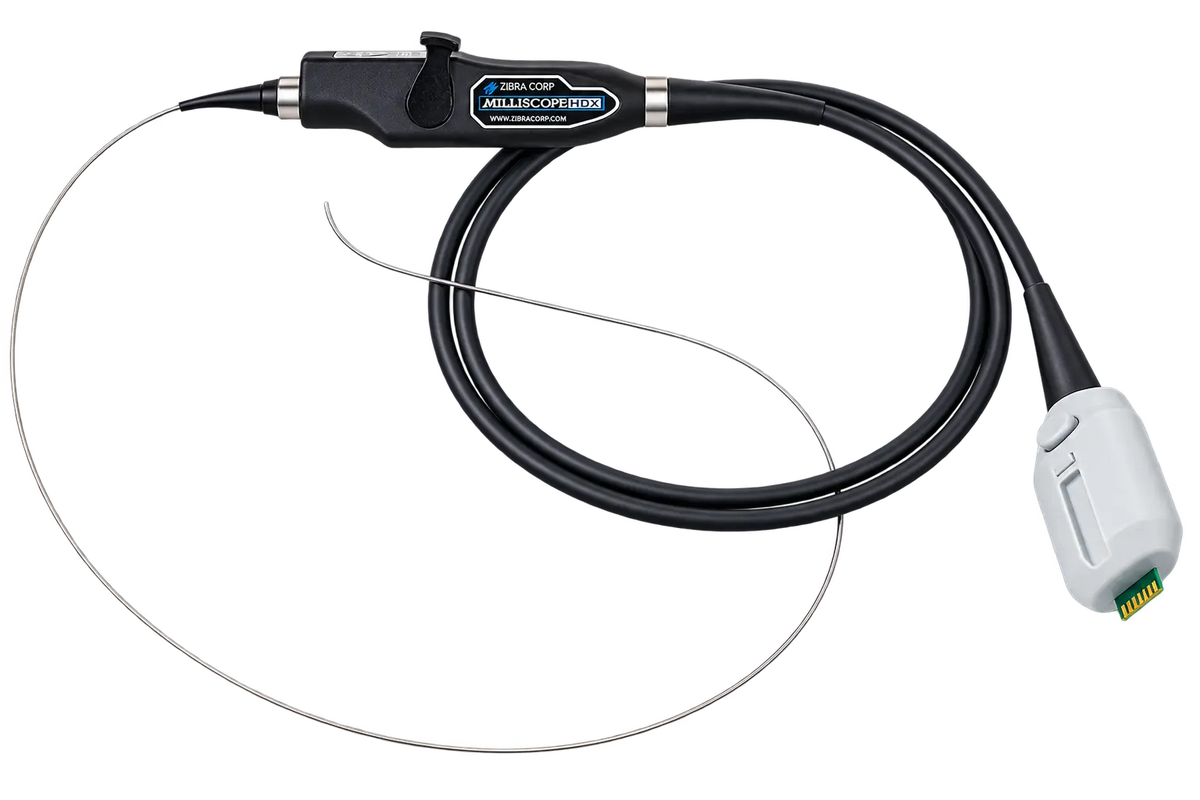
Milliscope HDX Articulating Micro Videoscope
HDX combines a 160,000-pixel CMOS sensor with two-way +/-170-degree tip articulation. Its 1.1 mm and 1.6 mm probes help inspect small components where the viewing direction needs to change after insertion.
It is particularly useful when access is narrow but the target sits around an offset or along a sidewall. The required diameter, length and viewing direction remain configuration-dependent.

AIT K Series HD Videoscope
K Series fits inspections where motor-driven articulation helps inspect around blades, welds, tubing paths and internal surfaces, subject to the selected probe configuration. It is a practical step up when the job no longer depends on micro-scale access.
This product family gives buyers a conventional industrial videoscope option with configurable probes, digital imaging and articulation for general RVI work across power generation, manufacturing and maintenance environments.

AIT T Series HD Videoscope
T Series uses mechanical articulation and suits industrial inspections where operators need steerable digital imaging across different access sizes, including specialized smaller probe options. It broadens the comparison beyond the Milliscope range.
With interchangeable probe configurations, T Series gives buyers another digital inspection option when a fiberscope cannot deliver the required field of view or inspection workflow.
In short, the Milliscope family is strongest when micro-scale access drives the decision, while K Series and T Series become more relevant once the opening allows a more conventional articulated video borescope.
How Does Ownership Change the Decision?
A fiberscope's coherent fiber bundle can develop permanent dark spots if individual image fibers break. Videoscopes avoid that particular failure mechanism, but their cameras, insertion tubes, connectors and articulating sections still need protection. Neither technology should be forced through a bend or an obstruction.
Service cost is also model-specific. Replacing a probe, servicing optics or upgrading within a modular platform may be more practical than replacing an entire system, but that depends on the fault and the available compatible components. AIT can help evaluate existing Milliscope equipment and available replacement configurations before a purchase.
For handling and bend-radius considerations, read AIT's articles on fiberscope care and maintenance and fiberscope bend radius.
The Inspection Opportunity That Does Not Wait
A precision component is on the bench for final inspection. The access hole measures less than a millimeter, and the team needs to see a specific internal surface before assembly. A digital camera with excellent imaging will not help if it cannot enter the opening. A fiberscope that reaches the cavity may still need a different viewing direction to show the exact feature.
Once the component is assembled or returned to service, getting another view could mean removing it again. Choosing between a videoscope and a fiberscope is therefore about the feature the inspector can see during the access window available. The correct probe is the one that reaches that feature and produces evidence the team can use.


