

Reach Smaller Openings
Probe diameters of 1.1 and 1.6 mm provide visual access through openings that may be inaccessible to larger inspection scopes.
Meet AIT at ASNT 2026, Visit Booth 803 | Columbus, Ohio | October 12-15, 2026

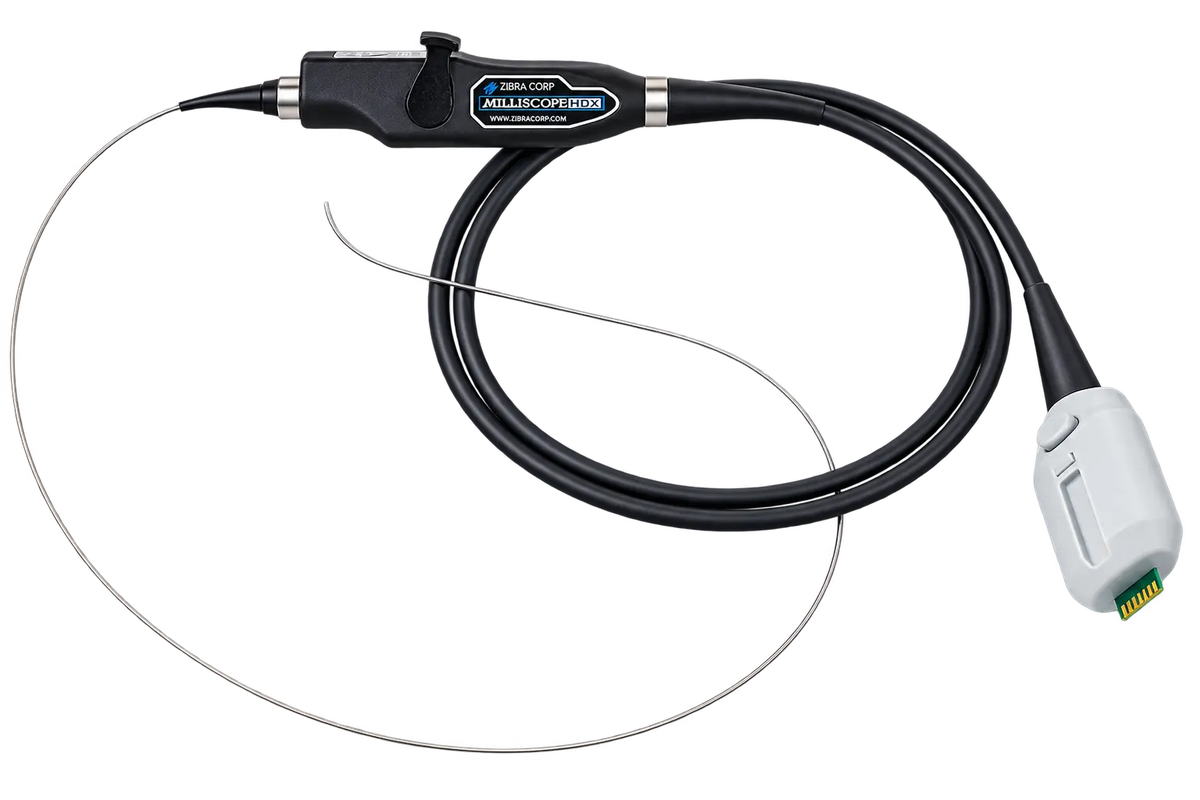


The Milliscope HDX is a small-diameter, high-resolution articulating micro videoscope that interfaces with the Milliscope HD base unit. A miniature 160,000-pixel CMOS image sensor combined with high-performance optics provides exceptional visualization in restricted areas. Milliscope HDX probes use durable shape memory metal outer sheathing for demanding inspection environments, with custom configurations available to meet specific inspection requirements.
 1.1 mm Access
Inspect extremely small openings
1.1 mm Access
Inspect extremely small openings
 +/-170° Articulation
Steer up and down
+/-170° Articulation
Steer up and down
 160K CMOS Imaging
Detailed restricted-area viewing
160K CMOS Imaging
Detailed restricted-area viewing
 Up to 1 m
Multiple shaft lengths available
Up to 1 m
Multiple shaft lengths available
Probe diameters of 1.1 and 1.6 mm provide visual access through openings that may be inaccessible to larger inspection scopes.

Two-way +/-170° articulation lets the inspector redirect the distal tip instead of relying solely on shaft positioning.

Shape memory metal outer sheathing provides a durable probe structure intended for demanding inspection environments.

Adjustable LED illumination plus selectable automatic and manual exposure gives inspectors more control over changing internal viewing conditions.

Capture still images and video directly to USB storage for inspection records, review and communication.

The Milliscope HD base unit supports HDX probes alongside HDV videoscopes and the fiberscope camera handle.
The Milliscope HDX is a small-diameter articulating micro videoscope for remote visual inspection of restricted internal areas. Available in 1.1 mm and 1.6 mm probe diameters, it combines a miniature 160,000-pixel CMOS image sensor with high-performance optics for visualization through exceptionally small access points.
Two-way +/-170° up/down articulation allows the distal tip to be redirected after insertion instead of relying only on probe position. Shaft lengths range from 150 mm to 1.0 m, with viewing directions from 0° to 90° depending on the selected probe configuration.
Adjustable LED illumination, automatic or manual exposure, and 90° image rotation help adapt the view as internal geometry and lighting conditions change.
Push-button image and video recording to USB storage lets inspectors retain visual evidence for review, documentation, and communication after the inspection.
The core probe values that determine access, steering, viewing coverage, and working distance.
The HDX operates with the Milliscope HD base unit, which also accepts HDV videoscopes and the fiberscope camera handle. AIT can help match probe diameter, length, viewing direction, and access geometry to the inspection.
Review the probe dimensions, articulation, optical performance, imaging controls, recording capabilities, and Milliscope HD platform compatibility below. Final probe selection depends on the required access path, reach, viewing direction, and inspection target.
Probe dimensions, shaft construction, steering range, viewing direction, and base-unit interface.
| Specification | Details |
|---|---|
| Probe Diameter | 1.1 mm and 1.6 mm |
| Shaft Length | 150 mm to 1.0 m |
| Shaft Material | Shape memory metal |
| Articulation | 2-way, +/-170° up/down |
| Viewing Direction | 0° to 90°, product specific |
| System Interface | Milliscope HD base unit |
CMOS sensor, viewing coverage, working focus range, illumination, exposure control, and image orientation functions.
| Specification | Details |
|---|---|
| Image Sensor | 160,000-pixel CMOS |
| Field of View | 120° diagonal FOV |
| Depth of Focus | 1 to 50 mm |
| Illumination | Integrated adjustable LED scope illumination |
| Camera Exposure | User-selectable automatic and manual modes |
| Image Rotation | Push-button rotation in 90° increments |
Inspection capture, USB storage, on-screen settings, and compatible Milliscope HD inspection components.
| Specification | Details |
|---|---|
| Still Image Recording | Push-button image capture |
| Video Recording | Push-button video recording |
| Recording Storage | USB storage drive |
| On-Screen Display | LED and camera gain settings |
| Base Unit Compatibility | Milliscope HDX videoscopes, HDV videoscopes, and fiberscope camera handle |
Configuration note: Viewing direction is product specific. Confirm the required probe diameter, shaft length, viewing direction, access path, and target geometry with AIT before finalizing the Milliscope HDX configuration.

Inspect internal passages where conventional articulating videoscope diameters prevent access.

Examine restricted internal geometry in manufactured components without relying on a fixed viewing direction.

Navigate narrow tubes and internal channels using a steerable 1.1 or 1.6 mm probe.

Access restricted internal features where small probe diameter and controlled articulation are required.

Visually examine internal cavities, passages and difficult-to-view areas in precision cast components.

Use configurable diameter, length and viewing direction for specialized prototype and engineering inspection requirements.
The Milliscope HD family uses one modular inspection platform with different scope technologies for different access requirements. Compare HDF fiber imaging, HDV fixed-view CMOS imaging, and HDX articulating CMOS imaging to determine which inspection approach best matches the access path and target.
Flexible and semi-rigid fiberscope configurations for extremely small access points, broad working-length requirements, and product-specific viewing directions.
Small-diameter digital videoscope probes for applications that need a CMOS sensor at the inspection end but do not require an articulating distal tip.
Small-diameter CMOS imaging with 2-way articulation for inspections where the probe must enter a restricted opening and redirect the view toward the target.
Start with access diameter, then compare imaging technology, working length, viewing direction, and whether distal-tip articulation is required.
| Compare | HDF Fiberscope | HDV Videoscope | HDX Articulating Videoscope |
|---|---|---|---|
| Inspection Technology | |||
| Scope Type | Flexible or semi-rigid fiberscope | Small-diameter videoscope | Articulating micro videoscope |
| Image Architecture | Fiber image bundle with HD camera handle | 160,000-pixel CMOS image sensor | 160,000-pixel CMOS image sensor |
| Distal Articulation | - | - | 2-way +/-170° |
| Access and Probe Configuration | |||
| Scope Diameters | 0.35 to 3.1 mm | 1.0, 1.2, 2.1, 2.6 and 3.1 mm | 1.1 and 1.6 mm |
| Published Shaft Lengths | 61 mm to 10,000 mm+ | 1,000 to 5,000 mm | 150 mm to 1.0 m |
| Viewing Direction | 0° to 110°, product specific | 0° or 90°, product specific | 0° to 90°, product specific |
| Probe Construction | Flexible and semi-rigid configurations | Rugged small-diameter probe | Shape memory metal outer sheathing |
| Optics and Viewing | |||
| Field of View | Product specific | 90° diagonal FOV | 120° diagonal FOV |
| Depth of Focus | Product specific | 3 to 50 mm | 1 to 50 mm |
| Optical Zoom | 3:1 in camera handle | - | - |
| Imaging and Documentation | |||
| Adjustable LED Illumination | Yes | Yes | Yes |
| Auto / Manual Exposure | - | Yes | Yes |
| 90° Image Rotation | - | Yes | Yes |
| Still Image Capture | Yes | Yes | Yes |
| Video Recording | Yes | Yes | Yes |
| USB Recording | Yes | Yes | Yes |
| Milliscope HD Platform | |||
| Milliscope HD Base Unit | Compatible | Compatible | Compatible |
| Custom Configurations | Available for application-specific requirements | Available for application-specific requirements | Available for application-specific requirements |
The right choice depends on what limits the inspection: access size, required reach, digital imaging, or the need to redirect the probe after insertion.
Start with HDF when the smallest possible diameter, fiber-based inspection, flexible or semi-rigid construction, or a very broad length range drives the selection.
Use HDV when a small digital videoscope can reach the target directly and an articulating distal tip is not required for the inspection path.
Choose HDX when restricted access must be combined with controlled tip articulation to redirect the view toward an internal feature after insertion.
Diameter alone does not determine the correct Milliscope configuration. AIT can review the minimum opening, required reach, inspection path, target position, viewing direction, and inspection objective before the final HDF, HDV, or HDX configuration is selected. Browse the full micro borescopes family when comparing access options.
Not necessarily. The HDX is valuable when access size prevents a larger articulating probe from reaching the inspection area. Larger-diameter scopes can be preferable when the access path allows them, particularly when greater illumination or other capabilities are needed. Small-diameter videoscopes are specialized inspection tools rather than universal replacements for larger probes.
Choose based on the entire access path, not simply the entry hole. Consider the smallest restriction, bends, required reach and clearance needed to articulate near the target. If both diameters physically fit, send AIT the component geometry and inspection objective so the complete configuration can be evaluated rather than choosing on diameter alone.
The two-way +/-170° steerable tip is designed to redirect the view after insertion. This can be useful for following curved geometry, bringing a sidewall or feature into view, and inspecting targets that are not directly in line with the access opening.
That depends on the inspection. One important difference is that the HDX places a miniature CMOS imaging sensor in an extremely small articulating probe. Industry reporting notes that earlier ultra-small inspection approaches often relied on fiber optics with substantially lower pixel counts and without comparable articulation.
The HDX is part of the Milliscope HD platform. The published system information says the base unit accommodates HDX probes as well as HDV videoscopes and a fiberscope camera handle. For an existing system, AIT should confirm the exact base-unit configuration before ordering an additional probe.
Custom configuration is part of the HDX product offering. If the standard diameter, length or viewing arrangement does not match the inspection, provide AIT with the component geometry and inspection requirements so the feasibility of a custom configuration can be evaluated.
Send the minimum access diameter, required insertion distance, internal path or bends, location of the inspection target, desired viewing direction and what you need to see or document. A drawing, component photo or inspection-path dimensions can help AIT evaluate which probe configuration fits the application.
Don't force the application into the HDX simply because it is the product being viewed. Other micro-inspection technologies exist below 1.1 mm, including non-articulating video and fiber-based solutions. AIT should evaluate the required access, steering and image requirements to determine the more appropriate inspection technology. Industry offerings demonstrate that sub-1 mm visual inspection is possible, but capabilities differ significantly by technology.


Smallest Access Diameter
Required Probe Reach
Inspection Path
Target Location
Required Viewing Angle
Inspection Objective


