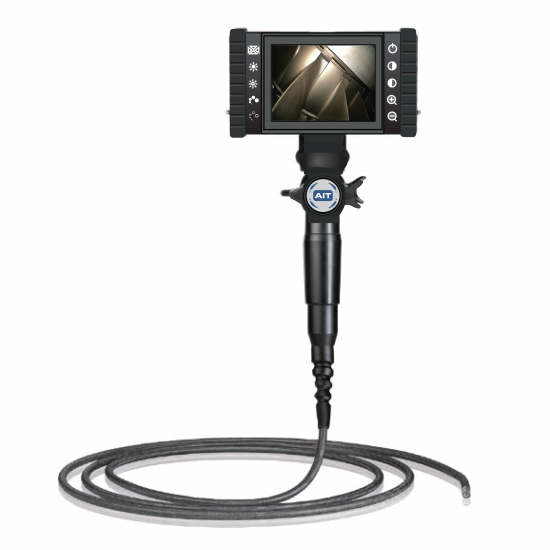
Inspect ports inside Zone 2 and Class I Division 2 areas with a videoscope rated for the location.
AIT VideoScope (AITVS) is AIT's articulating video borescope for engine, turbine, fuel-system and process cavities where a standard scope does not clear the hazardous-area review. Choose the probe diameter and insertion length, then request a quote for that configuration.
Is the AITVS explosion proof?
"Explosion proof" is the phrase most buyers search, and it has one precise meaning: a flameproof enclosure (Ex d) built to contain an internal ignition. AITVS uses a different protection concept, nonincendive (Ex ic), for areas where an explosive atmosphere is not expected during normal operation. Confirm your site's area classification and permit requirements before you mobilize; AIT does not classify areas.
Is the AITVS intrinsically safe?
Not in the sense most permits use the term. Intrinsically safe usually means Ex ia or Ex ib, the levels that limit stored energy low enough for Zone 0 or Zone 1, where an explosive atmosphere is present often or continuously. AITVS carries Ex ic, the Zone 2 level of protection under the same standard (EN 60079-11), on its externally accessible buttons and switches, plus Class I Division 2 in North America. We are not aware of any articulating videoscope in this class that holds an Ex ia or Ex ib rating. If your permit requires intrinsically safe equipment for Zone 0 or Zone 1 work, AITVS is not the instrument, and an AIT specialist will tell you that before you spend the money.
What the ratings mean
- Class I, Division 2 (National Electrical Code, NFPA 70 Article 500): a location where flammable gas or vapor is handled but is not normally present in ignitable concentration. Groups A, B, C and D cover acetylene, hydrogen, ethylene and propane-class gases, so AITVS is rated for the full gas range.
- ATEX II 3 G (Directive 2014/34/EU): Group II is surface industry (not mining). Category 3 is equipment for Zone 2. G means gas and vapor atmospheres. AITVS is not rated for combustible dust (Zone 21 or 22, or Class II). For Category 3 equipment the Directive provides for conformity to be declared by the manufacturer (Annex VIII) rather than examined by a notified body; the AITVS declaration is supported by evaluation to EN 60079-0, EN 60079-11 and EN 60079-15 and a technical file, and a copy is available on request.
- Ex ic nA: ic is the Zone 2 level of protection under the intrinsic safety standard (EN 60079-11) and nA is non-sparking construction under EN 60079-15. On AITVS, Ex ic covers the externally accessible buttons and switches and Ex nA covers the rest of the equipment, per the ATEX documentation.
- IIC: the most demanding gas group, which includes hydrogen and acetylene.
- T4: maximum surface temperature 135 °C, so it can be used around gases with an autoignition temperature above that.
- Gc: equipment protection level for gas, Zone 2.
- The X suffix on the ATEX documentation: special conditions for safe use apply. Reduce electrostatic charge build-up as the instructions describe, replace the battery only outside an explosive atmosphere and only with the specified type, and use the scope in areas of Pollution Degree 2 or better. The certified ambient range is -25 °C to +45 °C for the system and -25 °C to +80 °C at the probe tip.
What MIL-STD-810G (Change 1) Method 511.6, Procedure I tests
Method 511 is the Explosive Atmosphere method in MIL-STD-810G. Procedure I tests that the equipment operates in a fuel-air mixture without igniting it. Procedure II tests whether an enclosure contains an internal explosion. AIT system documentation for AITVS cites Procedure I, which is the test that matters for a videoscope going into a fuel tank or a fueled aircraft bay, because it checks whether the scope itself can ignite the atmosphere.
Handset display and sealed probe
The 5.0 inch thin-film transistor (TFT) color display sits on the handset, so one technician reads the image at the port without a laptop or a second person on a monitor. AITVS is offered in two standard configurations: with onboard still-image (BMP format) and video (MPEG4 format) capture to an SD memory card, time and date stamped, or without image capture or onboard storage for facilities that do not permit recording devices. The tungsten-braid insertion tube on a polyurethane jacket is waterproof to 14.7 psi (1 bar), and the three-stage light-emitting diode (LED) light source in the handle, delivered to the tip through a fiber-optic light guide, lets you cut the light on a bright reflective surface or push it into a dark cavity with no electrical light source at the probe end. The rechargeable lithium-ion battery runs the handset with no wall-power tether.
What ships in the case
Every AITVS ships as a complete kit: the handset and probe in your configured diameter and length, a rechargeable lithium-ion battery with charger, a neck holder, a user manual, a protective carrying case sized to the probe length, and an 8 GB SD memory card with capture-equipped configurations.
Buying from AIT also means you are not left guessing which diameter, length or articulation fits your port, or whether the rating fits your permit. AIT confirms the AITVS configuration against the access point and the site classification when you request a quote. Related lines: explosive environments, video borescopes, aviation, law enforcement and heat exchangers and condensers.
Bottom line: AITVS is for teams whose inspection sits inside a Zone 2 or Class I Division 2 boundary and who need the camera to pass the safety review as well as survive the environment. AIT VideoScope is an AIT product line, designed and specified by AIT, manufactured in the USA and supported by AIT Products, LLC.