

Avoid Blind Deployment
View remote dose-rate information through the controller while the probe is positioned in an inaccessible inspection area.
Meet AIT at ASNT 2026, Visit Booth 803 | Columbus, Ohio | October 12-15, 2026
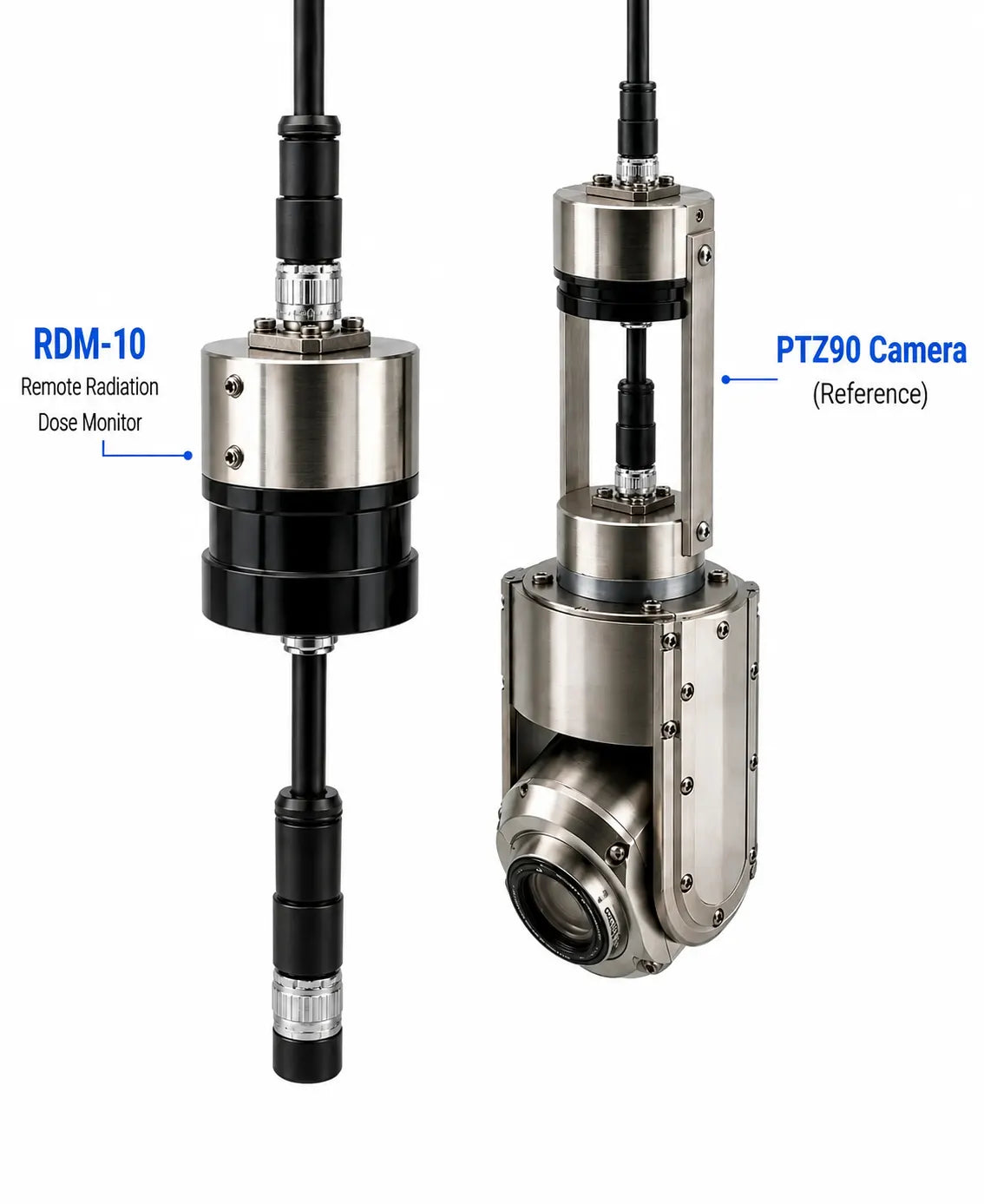


The AIT RDM-10 is a radiation monitor designed for remote dose-rate measurement in nuclear and industrial inspection environments. Unlike conventional handheld radiation monitors that are typically carried to the measurement point, the RDM-10 can be positioned remotely using a compatible cable-mounted or camera-assisted inspection configuration.
This remote deployment approach makes the RDM-10 particularly suited to inspection workflows where radiation measurements are needed at locations separated from the operator.
 Remote Dose Readout
View dose-rate data at the controller
Remote Dose Readout
View dose-rate data at the controller
 Inclination Included
Monitor probe orientation during deployment
Inclination Included
Monitor probe orientation during deployment
 Camera Optional
Operate alone or with a camera
Camera Optional
Operate alone or with a camera
 Two Mounting Modes
Mount at camera or cable end
Two Mounting Modes
Mount at camera or cable end
View remote dose-rate information through the controller while the probe is positioned in an inaccessible inspection area.

Integrate the sensor with compatible AIT PTZ controller and cable equipment instead of creating a separate deployment platform.

Combine radiation information with camera-assisted visual inspection when the selected configuration includes a compatible camera head.

Use integrated inclination measurement to understand sensor orientation during remote positioning and monitoring work.

Run the RDM-10 as a stand-alone sensor when the task requires measurement data without visual inspection.

Unlike handheld radiation meters that require an operator to carry the instrument, the RDM-10 is designed for remote positioning in nuclear and industrial inspection areas where personnel access may be limited.
The RDM-10 is a compact remote radiation dose-rate monitor with integrated inclination measurement. It connects through a compatible AIT PTZ controller and cable set, allowing measurement information to be viewed at the controller while the probe is deployed in an industrial or nuclear inspection area.
The unit can operate as a stand-alone cable-mounted sensor or be installed in line with a compatible camera. This allows inspection teams to collect radiation information alone or combine it with a remote visual inspection workflow.
Deploy the RDM-10 at the cable end when remote dose-rate and inclination information is required without an attached camera.
Install the RDM-10 in line with a verified compatible camera when measurement data and visual inspection are needed together.
Dose-rate and inclination information is displayed through the compatible PTZ controller, keeping measurement feedback at the operator's location.
A camera is not required. The RDM-10 can operate independently or with a compatible camera head using supported AIT PTZ cable infrastructure.
Review the camera head dimensions, imaging capability, zoom range, pan-and-tilt movement, lighting, pressure rating, submersibility, and PTZ-HD compatibility details below. XyloQ is positioned as the larger 140 mm PTZ camera head in the same inspection-camera family as AIT's PTZ90HD, PTZ70HD, PTZ45XD, PTZ35XD, and Micro PTZ systems.
Physical camera-head details for access planning, handling, and system configuration.
| Specification | Details |
|---|---|
| Camera diameter | 5.5 in / 140 mm |
| Technical model position | PTZ140HD camera head |
| Length | 8.9 in / 196 mm |
| Weight | 6.9 lb / 3.17 kg |
| Material | Nickel-plated aluminum / stainless steel |
| Cable stability | Center of gravity on axis center to help reduce cable sway |
HD video, wide dynamic range, and high zoom capability for long-range remote visual inspection.
| Specification | Details |
|---|---|
| Resolution | 1080p with wide dynamic range |
| Wide dynamic range | Yes |
| Optical zoom | 30x optical zoom |
| Digital zoom | 32x digital zoom |
| Maximum zoom | 960x AF zoom |
| Inspection use | Long-range viewing of tanks, vessels, pipes, chambers, and large internal spaces |
PTZ movement details for scanning large areas from a remote deployment point.
| Specification | Details |
|---|---|
| Pan angle | 360° continuous |
| Tilt angle | ±270° |
| Control style | PTZ-HD controller and cable set dependent |
| Best-fit movement use | Remote scanning of large tanks, vessels, pipes, chambers, and internal structures |
Integrated lighting details for dark, large, or distant inspection areas.
| Specification | Details |
|---|---|
| Illumination | Ultra-bright LED array lighting |
| Lighting control | Adjustable shadowless LED illumination |
| Directional lighting | Full illumination at 90 ft distance |
| Inspection use | Long-range visual coverage in dark tanks, vessels, submerged areas, and confined spaces |
Pressure, submergibility, and deployment information for wet or demanding inspection environments.
| Specification | Details |
|---|---|
| Pressure rating | 10 bar / 334 ft |
| Submergibility | Camera head can be pressurized and is submersible up to 100 m |
| Housing construction | Nickel-plated aluminum / stainless steel camera head construction |
| Typical environments | Industrial tanks, process vessels, large pipes, submerged areas, confined spaces, and hazardous-access inspection locations |
XyloQ is intended to extend the PTZ-HD camera-head range with a larger 140 mm option. Final setup depends on the selected controller, cable set, deployment method, and whether RDM-10 integration is required.
| Specification | Details |
|---|---|
| PTZ-HD compatibility | Compatible with PTZ-HD controllers and cable sets |
| Controller family | PTZ-HD controller and cable infrastructure |
| Related PTZ camera heads | PTZ90HD, PTZ70HD, PTZ45XD, PTZ35XD, and Micro PTZ |
| RDM-10 compatibility | Compatible with the RDM-10 Remote Radiation Dose Monitor |
| Configuration review | Confirm controller model, cable length, connector arrangement, deployment environment, access opening, and RDM-10 requirement before quoting |
Preliminary specification notice: Specifications and compatibility should be confirmed before ordering. Contact AIT to verify the current PTZ-HD controller, cable set, connector arrangement, deployment method, and RDM-10 integration requirements.

The compact 48 mm sensor diameter helps teams assess whether the monitor can pass through the available opening.

Collect remote dose-rate information from areas where direct operator access is limited or undesirable.

Add dose-rate and inclination information to a compatible remote nuclear inspection workflow.

Position the RDM-10 remotely for radiation awareness during industrial monitoring activities.
Combine radiation measurements with visual inspection using a verified compatible camera setup.

Deploy the sensor without a camera when measurement information is the primary requirement.
Traditional handheld radiation monitors require the instrument to be carried to the measurement location. The AIT RDM-10 takes a different approach by integrating radiation monitoring into a remote inspection workflow.
The RDM-10 is designed around remote positioning rather than requiring the instrument to remain in the operator's hand during measurement.
| Consideration | AIT RDM-10 | Conventional Handheld Meter |
|---|---|---|
| Operating approach | Designed for remote sensor deployment | Typically designed to be carried and operated as a handheld instrument. |
| Measurement location | The sensor can be positioned at the inspection point while measurement information is viewed through the compatible system. | The instrument is generally brought by the operator to the measurement location. |
| Inspection workflow | Built around remote inspection equipment | Primarily functions as an independent personnel-carried measuring instrument. |
| Camera relationship | Can support a compatible camera-assisted inspection configuration when visual context is required. | A handheld meter typically operates separately from the inspection camera workflow. |
| Camera-free use | Stand-alone remote operation supported | Handheld operation does not provide the same remote deployment arrangement. |
| Application focus | Developed for industrial and nuclear inspection environments where remote positioning can be valuable. | Well suited to general personnel-carried radiation measurement and spot-check applications. |
Place the sensing point where the measurement is needed while using a remote inspection configuration instead of relying on personnel-carried measurement at that location.
The RDM-10 is designed to work within a compatible remote inspection setup rather than functioning only as a separate handheld instrument.
Use the RDM-10 in a stand-alone remote arrangement or as part of a verified camera-assisted configuration based on the inspection task.
AIT can review your deployment method, controller and cable setup, and camera requirements before you request a final configuration.
The RDM-10 measures radiation dose rate and includes inclination measurement. Its dose-rate range is 10 µSv/h to 100 mSv/h, equivalent to 1 mrem/h to 10 rem/h, with accuracy of ±15%.
No. It can operate as a stand-alone sensor at the cable end. It can also be used in line with a compatible camera when the inspection requires both remote radiation information and visual observation.
The RDM-10 sends its measurement information through the compatible system so the dose-rate and inclination readings can be displayed on the connected AIT PTZ controller.
The source identifies two mounting arrangements: camera-mounted and cable-mounted. The correct arrangement depends on whether the inspection requires a camera, the available access path, and the verified controller and cable configuration.
The RDM-10 requires a compatible AIT PTZ controller and cable set and works with multiple camera heads. Compatibility should be verified by model because the supplied source does not provide a complete controller and camera matrix.
The specification sheet states that the controller provides an over-range indication when the measurement range is exceeded. It does not define an alarm level, alarm output, or automatic response.
Provide the camera model, controller model, cable length, connector photos, intended mounting method, access opening, expected dose-rate range, and whether you need stand-alone or camera-assisted deployment.


Access opening size or probe entry diameter
Inspection distance or working length required
Pipe, tank, or component dimensions
Environment: wet, hot, hazardous, explosive, confined space
Target defect: crack, corrosion, blockage, weld, FOD, leak
Purchase, rental, repair, or demo need


