

An ATEX marking is a compact equipment label that tells you where a device is intended to operate, what protection concept it uses, which gas group it covers, its temperature class and its Equipment Protection Level.
For inspection equipment, the marking should be read as one complete line. A correct Zone or gas group does not make the rest of the code optional. Match the full marking to the site's documented requirement before comparing probe diameter, reach, articulation or image quality.
Quick answer: Read an ATEX marking from left to right: equipment group and category, atmosphere type, Ex protection concept, gas group, temperature class and Equipment Protection Level. Then check any special conditions, ambient limits and approved configuration before the equipment is accepted for the job.
Start With the Full Marking, Not a Single Familiar Term
For AITVS, the ATEX marking is:
Each part answers a different approval question. Reading only "Zone 2," "IIC" or "T4" leaves the rest of the equipment conditions unchecked.
Group II identifies equipment intended for surface industries rather than mining.
Category 3 is associated with equipment intended for Zone 2 gas applications.
G identifies gas and vapor atmospheres. It does not indicate combustible-dust approval.
AIT documentation applies Ex ic to externally accessible buttons and switches and nA to the rest of the equipment.
IIC is the gas-group portion of the marking. AIT's dedicated gas-group article covers the IIA, IIB and IIC hierarchy in detail.
T4 limits maximum surface temperature to 135 degrees C under the certified conditions.
Gc is the gas EPL associated with the Zone 2 protection level.
The detailed relationship between Zones, categories and gas groups is already covered in AIT's ATEX ratings for inspection cameras and ATEX gas groups IIA, IIB and IIC. The point here is how to read the complete code without separating it into unrelated claims.
Read the Marking as a Sequence of Approval Checks
The complete code, operating limits and approved configuration need to line up with the facility requirement.
The AITVS Approval Package Goes Beyond the ATEX Marking
AITVS also carries North American hazardous-location approval and explosive-atmosphere test evidence. These documents answer different questions and should not be treated as interchangeable versions of the same certificate.
European hazardous-area marking for the AITVS Zone 2 configuration. AIT states that conformity is supported by evaluation to EN 60079-0:2012, EN 60079-11:2012 and EN 60079-15:2010.
UL certified for applicable Class I Division 2 gas and vapor locations, evaluated to ANSI/ISA 12.12.01-2015 and CAN/CSA C22.2 No. 213-16, with UL 60065 / CSA C22.2 No. 60065 electrical-safety evaluation listed by AIT.
AIT system documentation cites Procedure I, which evaluates operation in a fuel-air atmosphere without ignition.
Why the distinction matters: ATEX establishes a European hazardous-area conformity path, the UL Class I Division 2 approval addresses the North American classification system, and MIL-STD-810G Method 511.6 is a test method. They support different parts of an equipment review.
Special Conditions Can Matter as Much as the Main Code
The AITVS ATEX documentation includes special conditions for safe use. AIT lists requirements for reducing electrostatic charge build-up, replacing the battery only outside an explosive atmosphere with the specified battery type, and using the system in areas of Pollution Degree 2 or better.
AIT also lists a certified ambient range of -25 degrees C to +45 degrees C for the system and -25 degrees C to +80 degrees C at the probe tip. These limits belong in the equipment review because the approval applies within the documented conditions.
How AITVS Puts the Marking Into a Real Inspection System
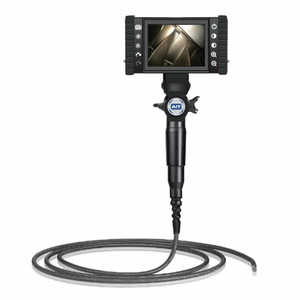
AIT VideoScope (AITVS)
AITVS is AIT's nonincendive articulating videoscope for applicable ATEX Zone 2 and Class I Division 2 inspections. It is offered in 28 configurations with probe diameters from 3.2 mm to 8 mm and insertion lengths from 1.5 m to 30 m.
The hazardous-location review comes before configuration details. Once the classification is accepted, the buyer can select the probe diameter, reach and articulation that fit the actual inspection path.
AIT can provide the applicable UL Certificate of Compliance and ATEX Category 3 documentation for safety-team review when requested.
What a Safety Reviewer Usually Needs Beyond the Product Page
A product page can show the headline marking, but an equipment review may require the supporting document, the exact model or configuration, ambient limits and any special conditions that apply to the approval.
A useful procurement record keeps the full marking and supporting approval documents together. If the same product family has multiple probe lengths or configurations, confirm that the quoted part number remains within the approved system configuration.
The ATEX marking tells a reviewer where to start, but acceptance depends on the complete approval package. Read the code left to right, then verify the certificate, operating conditions and exact configuration before the camera crosses the classified-area boundary.


