

ATEX gas groups IIA, IIB and IIC classify explosive gas atmospheres by characteristics that affect how easily ignition can occur. For inspection equipment, the group marking shows which gas families the equipment approval covers.
IIA is represented by propane, IIB by ethylene, and IIC by hydrogen and acetylene. Equipment marked IIC can be used where IIB or IIA equipment is required, while IIB equipment can cover IIB and IIA. Equipment marked IIA is limited to IIA applications.
Quick answer: IIA, IIB and IIC identify gas-group compatibility within Group II equipment for explosive gas atmospheres outside mines. IIC covers the widest gas-group range. The Zone, protection concept, temperature class and equipment protection level still need to match the site requirement.
What IIA, IIB and IIC Tell an Inspection Equipment Buyer
Gas group is one part of an ATEX or IECEx equipment marking. It describes the explosive gas atmosphere the equipment is designed and certified to handle. The classification is based on ignition-related properties such as maximum experimental safe gap and minimum ignition current.
IIA covers propane-type atmospheres and other gases with similar ignition characteristics. IIA equipment stays within the IIA group.
IIB covers ethylene-type atmospheres. Equipment marked IIB can also be used where IIA equipment is required.
IIC covers the most demanding Group II gas subdivision. Equipment marked IIC can also be used for IIB and IIA group requirements.
IECEx identifies IIA, IIB and IIC as subdivisions of Group II equipment used in explosive gas atmospheres outside mines. The representative gases are propane for IIA, ethylene for IIB, and hydrogen or acetylene for IIC. IECEx publishes the underlying equipment-group framework used for explosive atmospheres.
Why IIC Equipment Can Cover IIB and IIA Applications
The groups form a compatibility hierarchy. A location that requires IIA equipment can accept equipment marked IIA, IIB or IIC. A location requiring IIB can accept IIB or IIC. A location requiring IIC needs equipment marked IIC.
An IIA requirement can be met by equipment carrying any of the three Group II gas subdivisions.
An IIB requirement needs equipment marked IIB or IIC.
An IIC requirement calls for IIC-marked equipment.
Start with the gas group assigned to the location, then confirm the equipment marking covers that group. The equipment label should not be used to guess the site's classification.
Gas Group and Temperature Class Answer Different Questions
Gas group and temperature class often appear next to each other in an Ex marking, but they control different parts of equipment suitability. The gas group deals with the explosive characteristics of the gas or vapor. The temperature class limits the equipment's maximum surface temperature.
An inspection camera can carry the correct IIC gas-group marking and still be unsuitable if its temperature class or protection level does not match the site. That is why the complete marking needs to be reviewed together.
How the Gas Group Appears Inside a Full ATEX Marking
On inspection equipment, the gas group usually appears between the protection concept and the temperature class. In the AITVS marking, the relevant sequence is:
IIC is the gas-group portion of the marking. T4 is the temperature class, and Gc is the equipment protection level. The earlier parts of the marking identify the equipment group, category, gas atmosphere and protection concepts.
For the full marking structure, see AIT's ATEX ratings for inspection cameras.
How AITVS Uses an IIC Gas-Group Rating
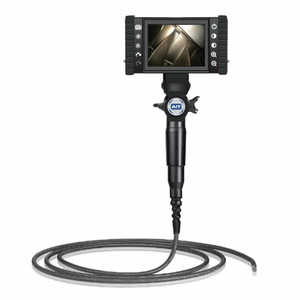
AIT VideoScope (AITVS)
AITVS carries the ATEX Zone 2 marking II 3 G Ex ic nA IIC T4 Gc. The IIC portion means its ATEX gas-group approval covers IIC, IIB and IIA gas-group requirements when the rest of the classification also matches.
The same product family is UL certified nonincendive for Class I Division 2, Groups A, B, C and D. These are separate classification systems, so each approval should be checked against the site's stated requirement rather than converted by assumption.
AITVS is available in 28 configurations with 3.2 mm to 8 mm probe diameters and 1.5 m to 30 m insertion lengths. Hazardous-area suitability comes first; probe diameter, reach and articulation are selected after the site classification is confirmed.
Product-fit boundary: The IIC marking does not by itself authorize use in every hazardous location. The Zone, category, protection concept, temperature class, EPL, ambient conditions and exact approved configuration still need to match.
When IIA, IIB or IIC Changes the Equipment Decision
Gas group becomes important whenever two pieces of inspection equipment appear similar on basic specifications but carry different Ex approvals. A camera can have the right reach, probe size and image quality and still fail the hazardous-area review because its gas-group marking stops short of the site's requirement.
IIA, IIB or IIC equipment can satisfy the gas-group portion of the requirement, subject to the rest of the marking.
IIB or IIC equipment can satisfy the gas-group portion. IIA equipment does not cover IIB.
The equipment needs an IIC marking. IIA or IIB equipment does not cover an IIC requirement.
Hazardous-area equipment is accepted on the complete marking, not on camera performance alone. If the site requires IIC and the equipment stops at IIB, image quality and probe reach never become part of the decision. Confirming the gas group early keeps the equipment review focused on cameras that can actually be considered for the job.


