

See the full length of the channel.
0.5 mm and 0.8 mm fiberscopes plus 1.0 mm and 1.9 mm CMOS videoscopes cover lumens from the smallest instrument channels up to larger endoscope working channels.
Meet AIT at ASNT 2026, Visit Booth 803 | Columbus, Ohio | October 12-15, 2026
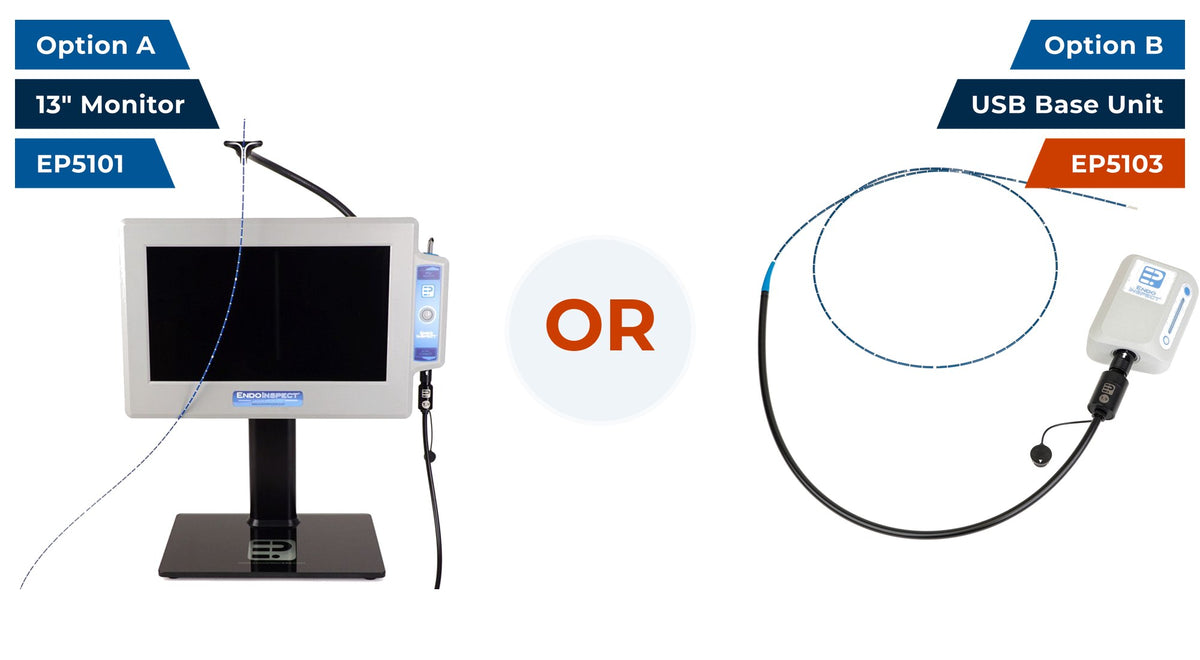


EndoInspect is a lumen inspection camera for sterile processing. EndoInspect is a borescope built for reprocessing rather than industrial inspection. SPD and CS technicians use it to see down endoscope working channels and surgical instrument lumens during flexible endoscope reprocessing, then save stills and video of what they find.
One base runs four scope diameters, from 0.5 mm fiberscopes for the smallest lumens to a 1.9 mm videoscope for endoscope working channels. Pick the 13" monitor base or the USB base for Windows.
AIT is the globally exclusive distributor of Endoprocess lumen inspection systems for SPD. For smaller channels, see Milliscope HD fiberscopes down to 0.35 mm.
EndoInspect is not a medical product and is not for patient use.
0.5 mm and 0.8 mm fiberscopes plus 1.0 mm and 1.9 mm CMOS videoscopes cover lumens from the smallest instrument channels up to larger endoscope working channels.

Scopes are interchangeable on both bases. Diameter is marked on the body and a centimeter scale runs along the shaft so findings can be located and recorded.

Bases are IP65 for decontamination and wet environments, wipe-only. Scopes are IP68 and can be submerged for optional high-level disinfection with the connector soaking cap fitted.

EP5101 saves images and video straight to removable USB storage with on-screen annotation. No computer or software license required.

EP5103 is USB-bus powered and writes .png stills and .mp4 video through the EndoInspect Viewer app on a Windows PC or full-Windows tablet.

EndoInspect is a visual inspection camera. It is not autoclavable, and it does not replace an AER, protein test, or audit software.
SPD / CS visual inspection and documentation of medical-device lumens and working channels during reprocessing. Aids visual detection of lumen damage, bioburden deposits, water/moisture, reprocessing-tool debris, rust/staining, and other common lumen contaminants. Not a medical product and not for patient contact.
| Part | Type | Diameter × length | Min. bend radius |
|---|---|---|---|
| EP5017 | Fiberscope | 0.50 mm × 80 cm | 10 mm |
| EP5016 | Fiberscope | 0.80 mm × 80 cm | 17 mm |
| EP5019 | CMOS videoscope | 1.0 mm × 100 cm | 25 mm |
| EP5018 | CMOS videoscope | 1.0 mm × 190 cm | 25 mm |
| EP5013 | CMOS videoscope | 1.9 mm × 100 cm | 35 mm |
| EP5012 | CMOS videoscope | 1.9 mm × 190 cm | 35 mm |
| EP5023 | CMOS videoscope, HI-RES | 1.9 mm × 100 cm | 35 mm |
| EP5022 | CMOS videoscope, HI-RES | 1.9 mm × 190 cm | 35 mm |
Common scope features: interchangeable on one base; diameter marked on the body; centimeter scale on the shaft; automatic white balance and LED adjustment; motion-detected LED sleep (monitor IFU); connector soaking cap required before submersion.
Daily: 70% IPA wipe if not visibly soiled. Optional HLD: Cidex OPA (preferred) or glutaraldehyde. Optional cold sterilization: STERRAD 100S, 50, NX, 100NX; STERIS V-PRO. Not compatible with autoclave, steam, high-temperature thermal, or automated endoscope reprocessors. Cap the connector before liquid.
Wipe only. 70% IPA, neutral detergent, or hospital low-level disinfectant wipes (OxyCide, Oxivir, SaniCloth or equivalent). Do not submerge EP5101 or EP5103. The system is not represented as waterproof. IP65 (bases) and IP68 (scopes) are the certified ratings.
One year against defects in materials and workmanship from first retail purchase. No coverage for user damage, wear, handling, or incorrect cleaning.
This is sterile processing after cleaning. You cannot see down the working channel.

Inspect gastroscope, colonoscope, and duodenoscope channels with the 1.9 mm videoscope after cleaning.

Adult bronchoscopes and EBUS use the 1.9 mm videoscope. Pediatric channels use 0.8 mm or 1.0 mm.

Ureteroscope lumens are small. Reach them with the 0.8 mm fiberscope.

Inspect cystoscope lumens with the 1.9 mm videoscope after cleaning.

Run the 0.5 mm fiberscope down shaver-handle cannulas after you brush.

The same 0.5 mm fiberscope reaches suction tubes and other cannulated instruments.
AORN Recommendation 9.4 and AAMI ST91 recommend a camera for accessible internal channels.
No. EndoInspect is a lumen inspection camera for reprocessing. It is not a medical product and is not for patient contact.
Both bases are IP65 for decontamination and wet environments. Wipe the base; do not dunk it. Scopes are IP68 for optional HLD soak. Choose diameter from the channel, not from which side of the department you are standing on.
HLD soak is optional and listed (Cidex OPA preferred). Autoclave, steam, and high-temperature thermal methods are not compatible. Automated reprocessors are not compatible.
Do not force the shaft. 0.5 mm and 0.8 mm fiberscopes for the smallest lumens; 1.0 mm and 1.9 mm videoscopes for larger working channels. Lengths: fiberscopes 80 cm; videoscopes 100 cm or 190 cm. If the channel binds, step down a diameter.
EP5101 gives you a dedicated screen in SPD with no PC. EP5103 writes files to a normal Windows folder if you already run Windows PCs or Surface-class tablets. Scopes are common to both. USB HI-RES 1.9 mm scopes (EP5022 / EP5023) are listed only in the USB IFU.
No. It is the visual-inspection camera for channels and lumens. It does not replace washer-disinfectors, AERs, or software audit platforms.
Smallest channel inner diameter you must enter
Channel length and whether a 190 cm single pass is needed
Device types in scope (flexible endoscopes, shavers, suction, cannulated instruments)
Dirty side, clean side, or both
Whether a Windows PC is available at the inspection point
Whether HLD soak is part of your workflow