

Long-reach borescope inspection is not simply a matter of ordering a longer insertion tube. Once reach moves into the 10-to-30-meter range, steering response, probe support, orientation and deployment method can change enough to determine whether the camera can actually inspect the target.
For buyers, the important question is not "How long can the borescope be?" It is "What control do I still have when the probe reaches the area I need to see?" At 10 meters, articulation may still be available. At 15, 20 or 30 meters, the job can become less about steering the tip and more about controlling the route.
Quick answer: Long-reach borescopes should be selected by reach and controllability together. A 10 m probe can still provide active steering on some systems, while 15 to 30 m configurations may trade articulation for reach. The inspection path decides whether that trade is acceptable.
Why Long-Reach Inspection Changes Once You Pass 10 Meters
Most standard articulating videoscopes are designed around relatively short insertion lengths. The market changes quickly once the inspection requires 10 meters or more. Some suppliers offer articulation around the 7 to 10 meter range, while 20 and 30 meter systems are often non-articulating or use a different deployment method.
That means "30 meter borescope" can describe very different tools. One may be a flexible video probe with active steering, another may be a straight-view cable on a reel, and another may behave more like a push camera.
Long enough to create handling challenges, but still within the articulating range of selected industrial videoscopes.
Route geometry and probe support become more important as active steering options narrow.
Best suited to paths where the insertion route itself can guide the probe toward the target.
Useful for deep straight or gently routed paths where inspection would otherwise require major disassembly.
Across long-reach systems, articulation is more common at shorter insertion lengths, while 20- and 30-meter configurations are often non-articulating. That is why reach should not be compared as a single specification.
At 10 Meters, Articulation Becomes the Question
Ten meters is an important transition point because it can still support active steering, but the articulation may not behave like a 3- or 5-meter probe. The longer the insertion tube, the more cable length sits between the operator and distal tip, and the route can absorb part of the control input.
On AITVS, the 6 mm and 8 mm probes are fully four-way articulating through 7.5 m. At 10 m, they retain four-way movement, but tip travel is limited to 90 degrees. That is a different operating envelope, not simply a longer version of the 7.5 m probe.
If the target requires looking sharply back toward a sidewall, weld or feature behind the tip, limited articulation may matter more than the additional 2.5 m of reach. If the route is mostly forward-looking, the same 10 m configuration can still be a strong fit.
The 6 mm and 8 mm AITVS probes retain full four-way articulation through this range.
Four-way movement remains, but distal tip travel is limited to 90 degrees.
Reach continues, but these long AITVS configurations no longer provide active tip steering.
At 15 to 30 Meters, the Inspection Path Starts Steering the Probe
When active tip articulation is removed, the route itself becomes part of the navigation system. A straight tube, open vessel wall, vertical drop or gently routed conduit can guide a long probe effectively. A path with repeated elbows, offsets or a need to look behind features is a different job.
Reach can be more valuable than steering when the probe can follow a known path toward a target that is generally in front of the camera.
Extra length does not solve a route that needs repeated active aiming. A shorter articulating system, another access point or a different inspection platform may be the better answer.
This is where a long borescope and a push camera can begin to overlap in search results but not necessarily in use. Push cameras are designed around pushing a cable or rod through longer lines. A videoscope is typically selected when a smaller probe diameter, close internal view or compact access port matters. For narrow internal passages and cross-holes, AIT's borescope guide for passages, cavities and cross-holes explains how route geometry changes camera selection.
Longer Reach Can Reduce Control Even When the Camera Still Reaches the Target
A long insertion tube introduces practical handling effects that are easy to miss on a specification sheet. Excess probe length must be stored and controlled outside the inspection point, and unsupported sections can twist, loop or transmit movement unevenly.
Long flexible sections can absorb rotation or movement before that input reaches the distal end.
Guide tubes, existing pipe geometry, vessel walls and entry orientation all affect how predictably the tip moves.
When the probe is deep inside an asset, small changes at the operator end can create larger uncertainty about camera orientation.
Selection rule: Do not buy 30 m because 30 m is available. Buy the shortest probe that reaches the inspection target with enough routing allowance to work comfortably. Extra length is useful only when the inspection actually needs it.
How AITVS Covers the 10 to 30 Meter Long-Reach Range
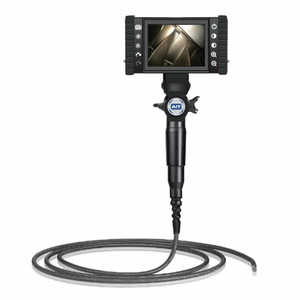
AIT VideoScope (AITVS)
AITVS spans 3.2 mm to 8 mm probe diameters and 1.5 m to 30 m insertion lengths across 28 configurations. For long-reach work, the important part is how steering changes as the length increases.
The 6 mm and 8 mm probes provide full four-way articulation through 7.5 m, four-way movement limited to 90 degrees at 10 m, and non-articulating configurations at 15 m and longer. The 8 mm family extends to 30 m.
AITVS is also rated for applicable Class I Division 2 and ATEX Zone 2 areas. If the inspection is inside a classified location, read AIT's ATEX ratings guide for inspection cameras before treating reach as the first selection criterion.
If the job is in a classified area, hazardous-location approval still comes before length. AIT's Explosion-Proof Borescope Selection Guide explains how to match the area classification with the appropriate videoscope configuration.
The Longest Probe Is Not Always the One That Sees the Most
Long-reach inspections create an unusual buying decision: adding reach can increase access while reducing the operator's ability to choose exactly where the camera looks. That trade becomes more important as the target moves from "somewhere at the end of this run" to "this weld, sidewall or feature at a specific angle."
A 10 m articulating configuration may justify the extra control if the target sits around a bend or on a sidewall.
A non-articulating probe can make sense when the camera only needs to follow the path and reach the viewing area.
If there is no closer port and the route is suitable, the ability to reach the area may matter more than active tip steering.
That is the part of long-reach borescope selection that specifications rarely make obvious. Reach and control are two different capabilities. The right configuration is the one that preserves enough of both for the exact inspection path, not the one with the biggest number on the datasheet.


